
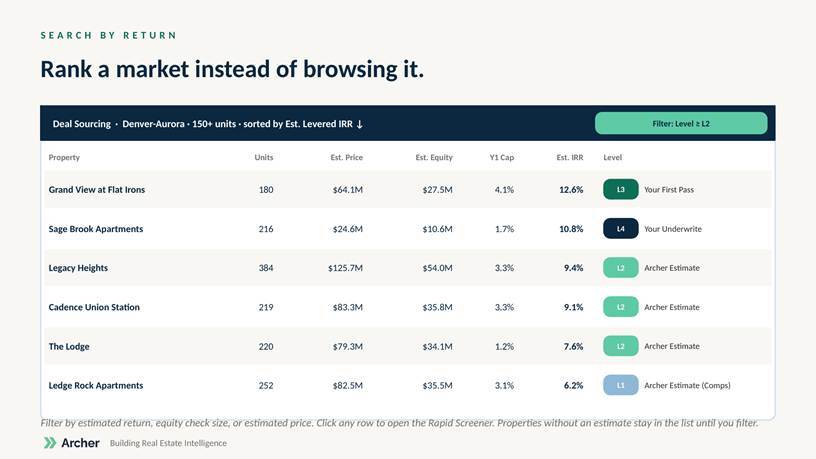
Every property in Deal Sourcing now carries an estimated return. Filter by it, sort by it, and rank a market instead of browsing it.
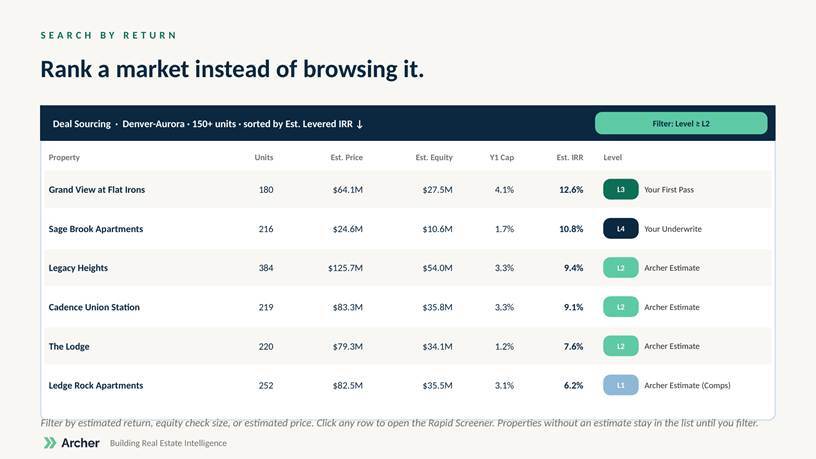
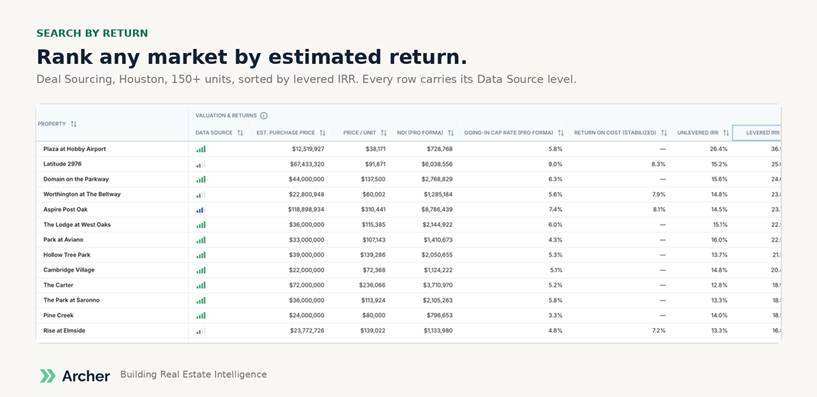
Deal Sourcing has had more than 150 filters for a while: units, vintage, class, owner, loan maturity, whether the property has traded, how long it’s been held. What it never had was the filter that matters most. Today it does. You can filter and sort any market by estimated return.
What changed
The engine behind the Rapid Screener, ACE, the Archer Calculation Engine, now runs across the market. Every property with enough data arrives with an estimated income, an estimated price, and the return that price implies. In Deal Sourcing you can filter by estimated return, by equity check size, or by estimated purchase price, and sort the results.
Properties we can’t estimate stay in your results until you apply a valuation filter, so nothing disappears on you. Most properties with five or more units carry an estimate; the blanks cluster in the very small stuff.
Click any row and the Rapid Screener opens on that property. The estimate you ranked on is the one you can now interrogate.
How the estimate is built
The estimate sets a price and shows you the return at that price. That’s the way most models work, including most custom models: enter a price, review the returns that result.
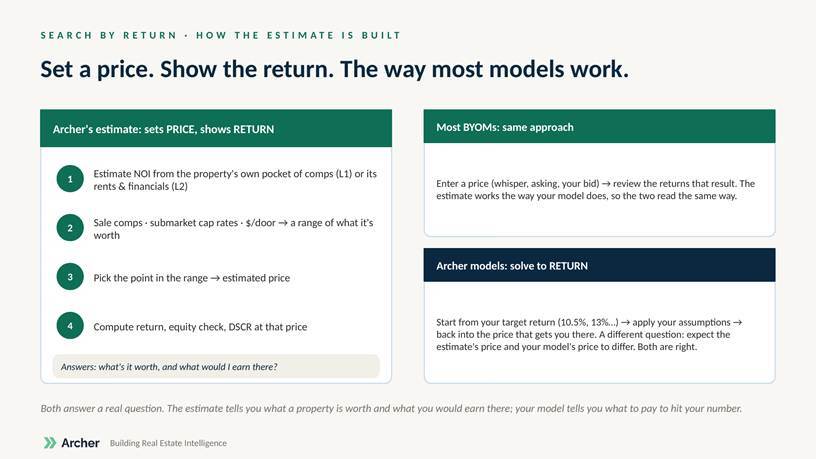
Income comes first: the property’s own rents where we have them, comparable properties where we don’t. Price comes from sale comps, submarket cap rates and price per door, giving a range of what the property is worth. Then leverage at current market terms, a multi-year forecast that reassesses taxes on acquisition, and a projected return at an assumed hold.
If you use one of Archer’s models, yours solves the other way, starting from a target return and backing into price. Both are valid. They answer different questions, and it’s why market estimates spread across a range while a portfolio of underwrites clusters at your target.
Why the levels matter here
Ranking a market by return only works if you know what each number is made of. That’s what the level is for.
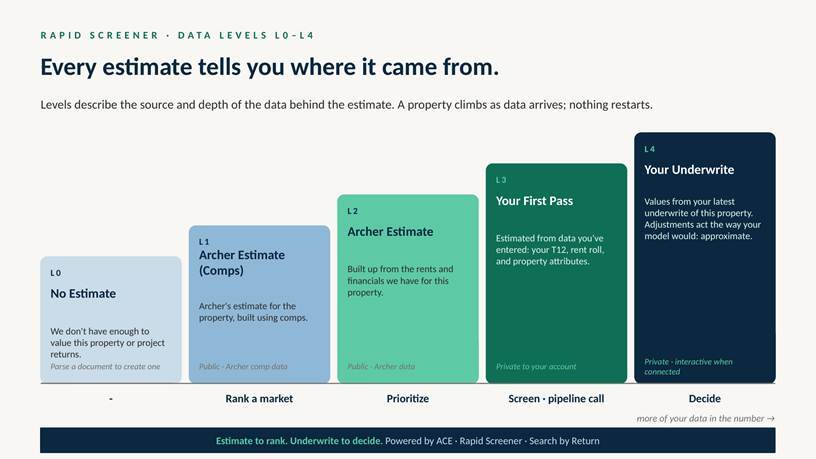
A Level 1 estimate is built from comps alone and tends to run conservative; on a small building with missing attributes it can be well off. A Level 2 has the property’s own rents or financials behind it and is meaningfully better. The moment you add a rent roll or correct a unit count, it becomes yours at Level 3. The filter for level lets you rank on the estimates you trust and set the rest aside.
What to do with it
This is the picture we’re after.
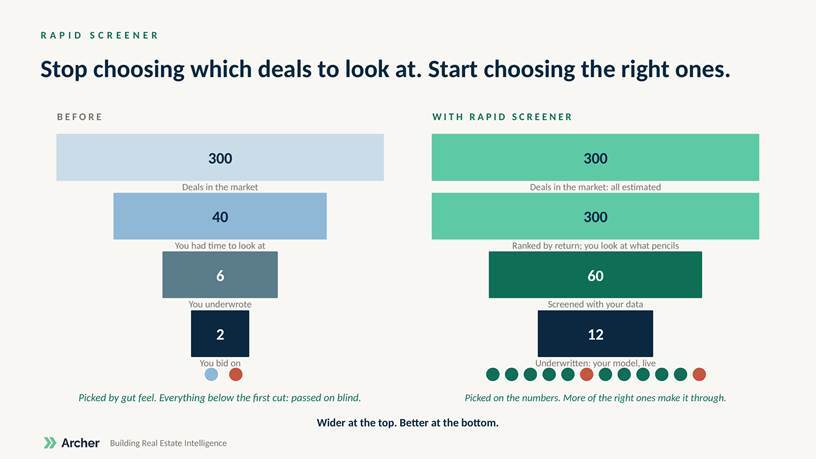
Before, you had time to look at a fraction of the market, and the ones you looked at were chosen by proxies: unit count, submarket, who the broker was. Now every property has a number. You look at what pencils, and the ones that get an hour of your time are the ones the numbers picked, not the ones that happened to arrive first.
Every estimate lands with its level. Where the number and your read disagree, that’s usually the property to open, because a corrected attribute or a rent roll turns Archer’s estimate into yours, and the gap tells you something.
What it isn’t
An estimate is a starting point, not a verdict. It can rank a market. It cannot price a deal. We’ve measured these estimates against thousands of owner-reported financials: they lean conservative, and they get meaningfully better as your own data comes in. If you want the detail behind that, reply to the launch email and we’ll send it.
FAQ
Why do similar properties show different returns? Each is estimated from its own comps and income. Low cap rates plus today’s rates mean smaller loans and bigger equity checks, which is why filtering by equity check is often the more useful cut.
A property I know shows a price that’s wrong. Check the level. A Level 1 has no operating data on the property. Correct the attributes or add financials and it re-estimates from your data.
The filter is slow. It is, today. It doesn’t yet show that it’s applying. We’re on it.
Can I see the estimate on properties I own? Yes, on the property page. We’ll be putting a starting valuation on portfolio properties next; if you disagree with it, run an underwrite and it becomes yours.