
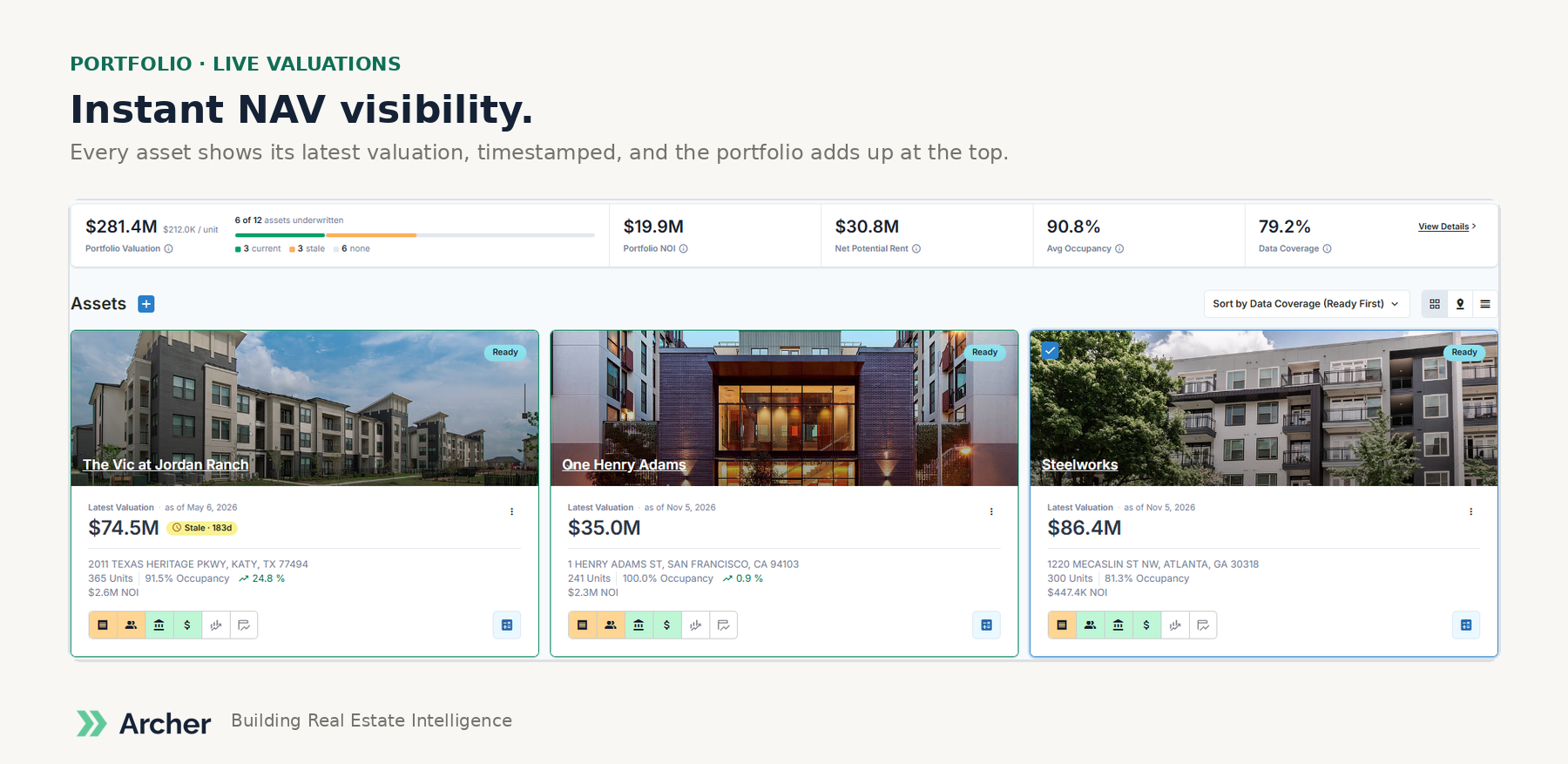
Almost every owner answers that once a quarter, by hand. Archer now answers it every day, from your own underwrites.
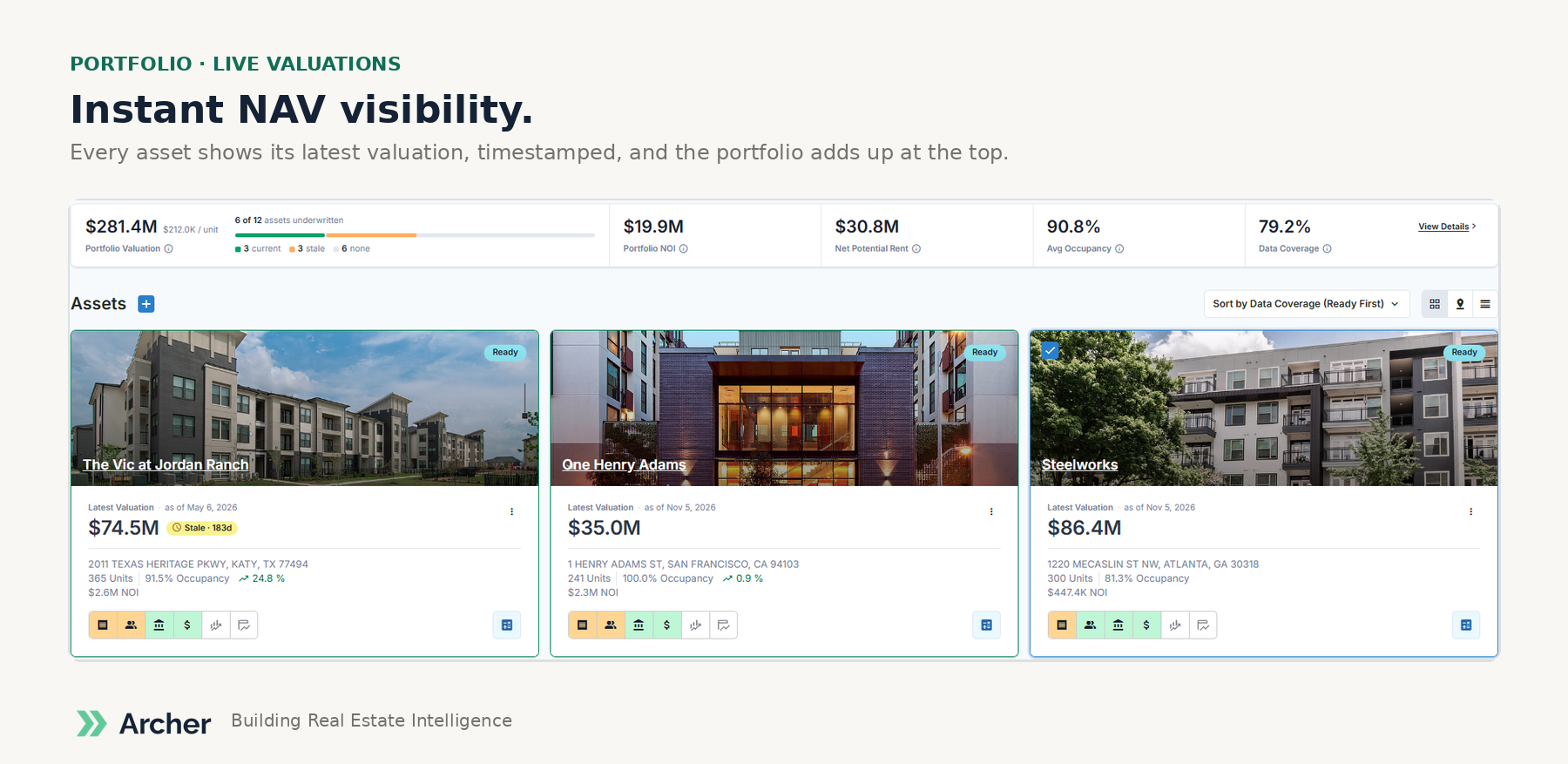
Ask an owner what their portfolio is worth and you’ll get one of two answers. The number from the last quarterly process, which is already a few months old. Or a pause, because the question is harder than it sounds.
We’ve asked it on a lot of calls this fall. Here’s some of what we heard.
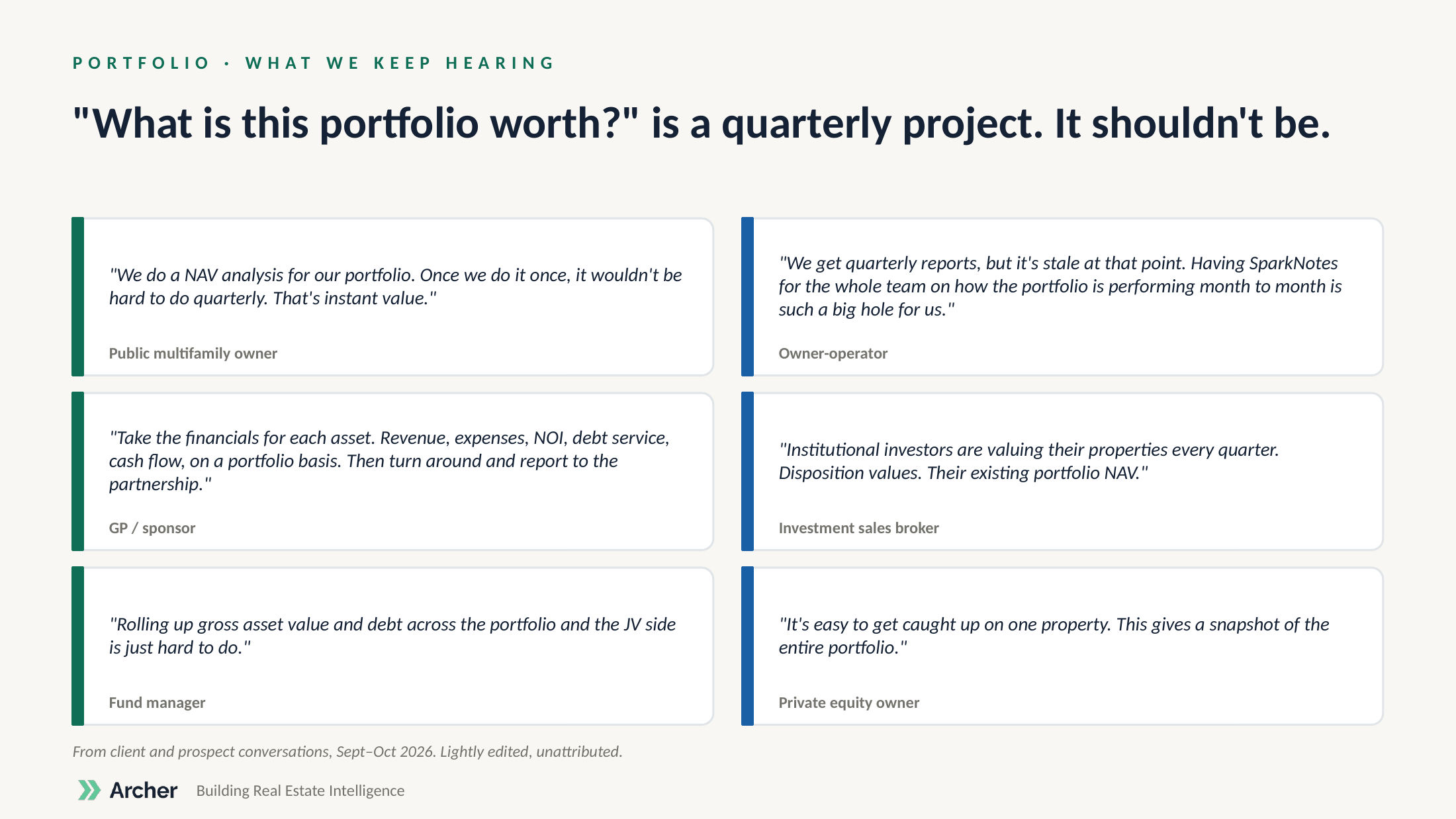
An institutional owner told us they run a NAV analysis on the portfolio and that once it’s set up, doing it quarterly wouldn’t be hard, which they called instant value. An operator said the quarterly reports they get are stale by the time they arrive, and what the team needs is the short version of how the portfolio is doing month to month. A sponsor wanted every asset’s financials boiled down to revenue, expenses, NOI, debt service and cash flow on a portfolio basis, so they could turn around and report to the partnership. A fund manager said rolling up gross asset value and debt across the portfolio and the JV side is just hard to do.
Different firms, same gap. The data to answer the question exists. It’s in a dozen Excel files, each one last opened when the deal closed.
What’s live
Every asset in your Portfolio now carries its latest valuation, taken from your most recent underwrite on that property, timestamped, and added up at the top of the page. Portfolio total, per-unit value, how many assets are underwritten, and how many of those valuations are current, stale, or missing. Portfolio NOI, net potential rent and occupancy alongside.
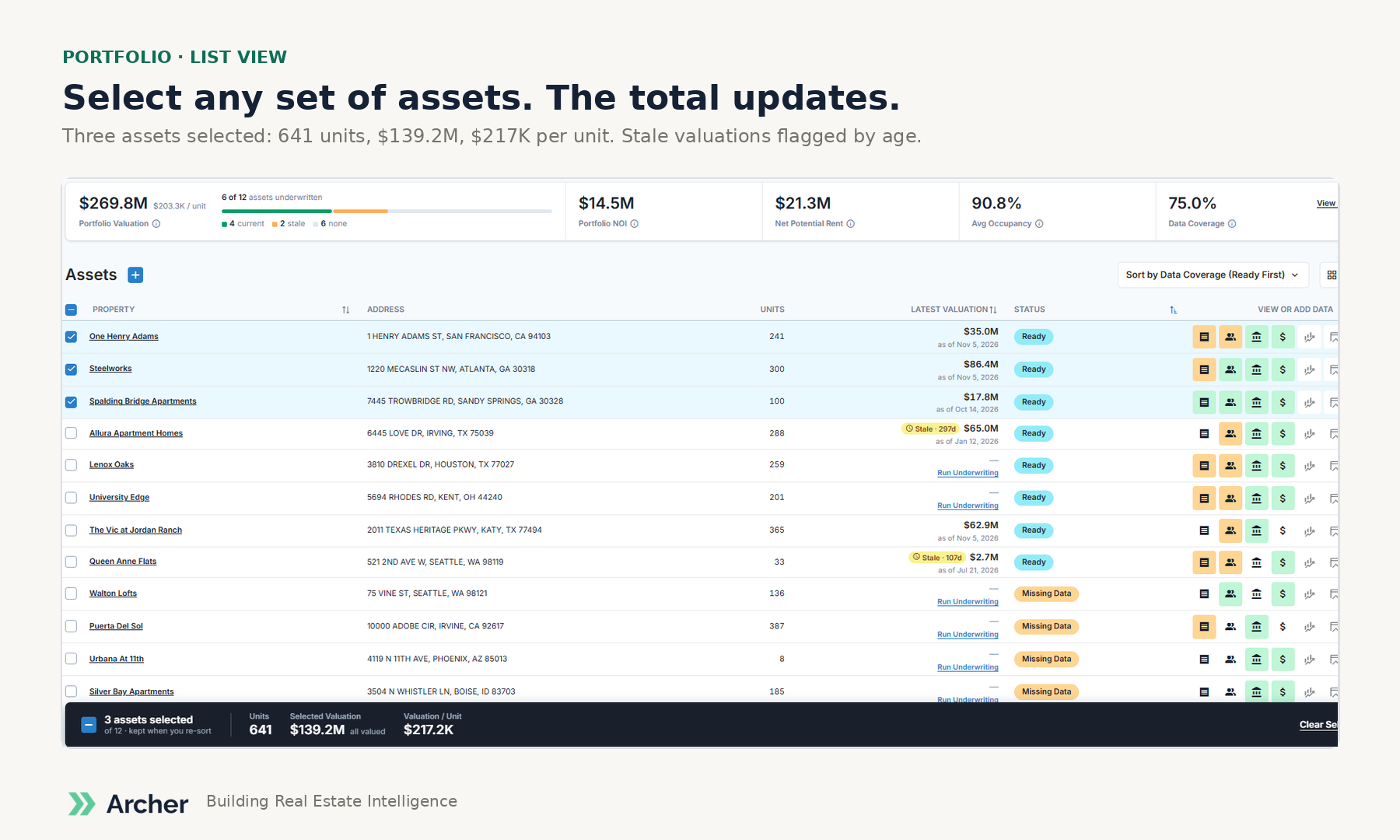
Select any set of assets, a fund, a state, the JV side, and the total updates for the selection: units, combined valuation, valuation per unit. The list view carries the same numbers and the same multi-select.
And the Rapid Screener now runs from the Portfolio page. Open any asset from its tile, see your latest underwrite, and move price, exit cap, hold period, rent growth or leverage to test a what-if without leaving the page. The portfolio stops being a list of numbers you read once a quarter and becomes something you can interrogate on a call.
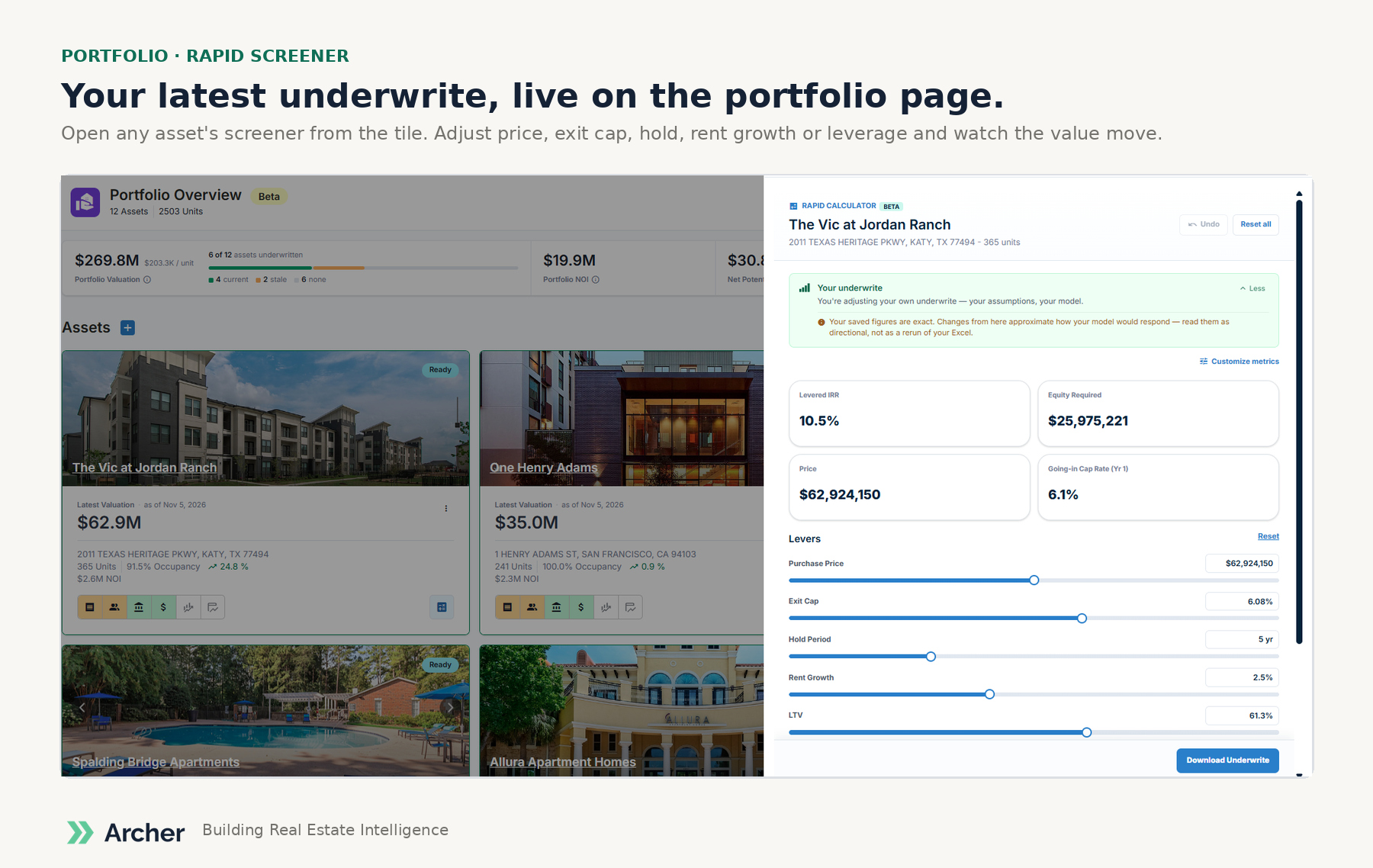
Where the number comes from
This matters, so we’ll be precise. The valuation on each asset is the purchase price from your most recent saved underwrite. Your model, your assumptions, your number. Archer doesn’t estimate it; Archer shows it back to you, with the date, and flags it when it’s gotten old.
That’s deliberate. The portfolio page is where you report to partners and lenders, and the number on it should be one you’d defend. If you want Archer’s market estimate for comparison, it’s on every property in Deal Sourcing, labeled by its Data Source level. The portfolio shows yours.
Why this is step one
What’s live today answers “what is it worth, as of the last time we looked.” The question owners actually want answered is “what is it worth now.” Three steps get there.
Step one, live today. Show what you already have. Every asset, every underwrite, one page, any grouping.
Step two. Keep it current. When a new T12 or rent roll lands for an asset, Autopilot re-runs the underwrite with your assumptions and the valuation updates. Nobody opens a model. This is what Autopilot, which also launched today, is for.
Step three. Roll it up and report. Revenue, expenses, NOI, debt service and cash flow across any grouping, against budget, gross asset value and debt together, in a view you can hand to the partnership.
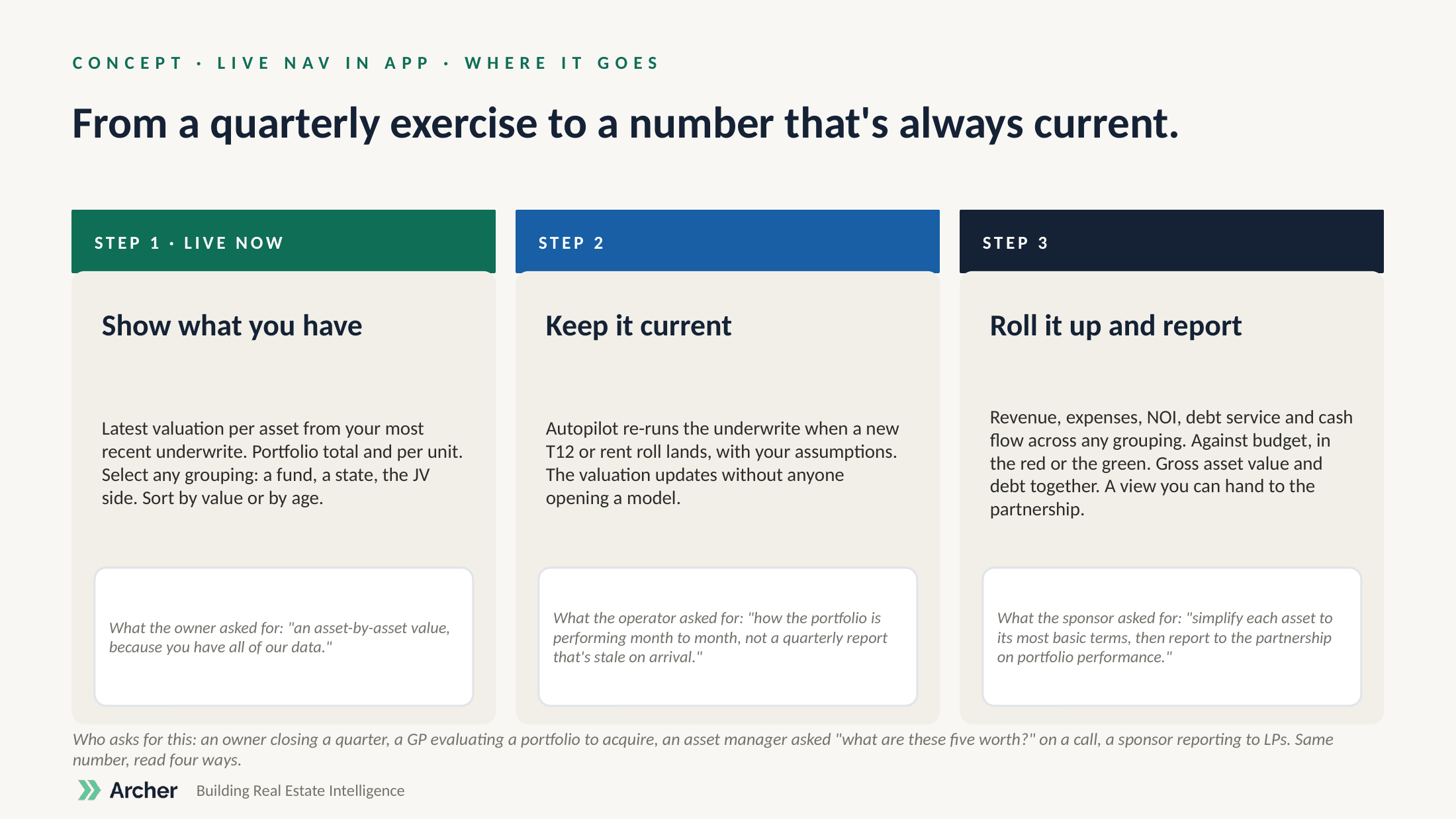
The institutional owner was right. Once it’s set up once, quarterly isn’t hard. The point of doing it this way is that quarterly stops being the unit. The number is just there.
What it isn’t
It isn’t an appraisal and it isn’t a mark-to-market. It’s your own underwriting, organized. For a formal valuation you still need a formal valuation. For knowing what the portfolio looked like the last time your team ran the numbers, and for noticing when that was too long ago, this is the page.
FAQ
Why is an asset showing no valuation? It has no saved underwrite yet. Run one and the value appears.
Why is an asset marked stale? Its latest underwrite is more than 90 days old. Run a new one to refresh the value and the date.
Can I see Archer’s estimate next to mine? On the property page, yes. The portfolio shows your underwrite only, by design.
Can I export this? The list view exports to Excel with the valuation column and your selection.
What about debt and equity? Step three. Today’s page shows asset value. Rolling up debt, equity and cash flow across the portfolio is where this goes next.